Dante Alighieri (1265-1321)
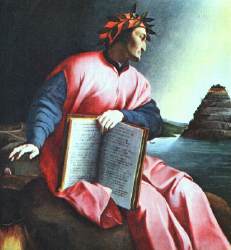 Dante is Italy's greatest poet and also one of the towering figures in western European literature. He is best known for his monumental epic poem, La commedia, later named La divina commedia (The Divine Comedy). This great work of medieval literature is a profound Christian vision of man's temporal and eternal destiny. On its most personal level, it draws on the poet's own experience of exile from his native city of Florence; on its most comprehensive level, it may be read as an allegory, taking the form of a journey through hell, purgatory, and paradise. The poem amazes by its array of learning, its penetrating and comprehensive analysis of contemporary problems, and its inventiveness of language and imagery. By choosing to write his poem in Italian rather than in Latin, Dante decisively influenced the course of literary development. Not only did he lend a voice to the emerging lay culture of his own country, but Italian became the literary language in western Europe for several centuries. In addition to poetry Dante wrote important theoretical works ranging from discussions of rhetoric to moral philosophy and political thought. He was fully conversant with the classical tradition, drawing for his own purposes on such writers as Virgil, Cicero, and Boethius. But, most unusual for a layman, he also had an impressive command of the most recent scholastic philosophy and of theology. His learning and his personal involvement in the heated political controversies of his age led him to the composition of De monarchia, one of the major tracts of medieval political philosophy.
Most of what is known about Dante's life he has told himself. He was born in Florence in 1265 under the sign of Gemini (between May 21 and June 20) and remained devoted to his native city all his life. Dante describes how he fought as a cavalryman against the Ghibellines, a banished Florentine party supporting the imperial cause. He also speaks of his great teacher Brunetto Latini and his gifted friend Guido Cavalcanti, of the poetic culture in which he made his first artistic ventures, his poetic indebtedness to Guido Guinizelli, the origins of his family in his great-great-grandfather, Cacciaguida, whom the reader meets in the central cantos of the Paradiso (and from whose wife the family name, Alighieri, derived), and, going back even further, of the pride that he felt in the fact that his distant ancestors were descendants of the Roman soldiers who settled along the banks of the Arno.
Yet Dante has little to say about his more immediate family. There is no mention of his father or mother, brother or sister in The Divine Comedy. A sister is possibly referred to in the Vita nuova, and his father is the subject of insulting sonnets exchanged in jest between Dante and his friend Forese Donati. Because Dante was born in 1265 and the exiled Guelfs, to whose party Dante's family adhered, did not return until 1266, Dante's father apparently was not a figure considerable enough to warrant exile. Dante's mother died when he was young, certainly before he was 14. Her name was Bella, but of which family is unknown. Dante's father then married Lapa di Chiarissimo Cialuffi and they produced a son, Francesco, and a daughter, Gaetana. Dante's father died prior to 1283, since at that time Dante, having come into his majority, was able as an orphan to sell a credit owned by his father. The elder Alighieri left his children a modest yet comfortable patrimony of property in Florence and in the country. About this time Dante married Gemma Donati, to whom he had been betrothed since 1277.
Dante's life was shaped by the long history of conflict between the imperial and papal partisans called, respectively, Ghibellines and Guelfs. Following the middle of the 13th century the antagonisms were brutal and deadly, with each side alternately gaining the upper hand and inflicting gruesome penalties and exile upon the other. In 1260 the Guelfs, after a period of ascendancy, were defeated in the battle of Montaperti, but in 1266 a force of Guelfs, supported by papal and French armies, was able to defeat the Ghibellines at Benevento, expelling them forever from Florence. This meant that Dante grew up in a city brimming with postwar pride and expansionism, eager to extend its political control throughout Tuscany. Florentines compared themselves with Rome and the civilization of the ancient city-states.
Not only did Florence extend its political power, but it was ready to exercise intellectual dominance as well. The leading figure in Florence's intellectual ascendancy was a returning exile, Brunetto Latini. A contemporary historian, Giovanni Villani, characterized Latini as the "initiator and master in refining the Florentines and in teaching them how to speak well, and how to guide our republic according to political philosophy [la politica]." Despite the fact that Latini's most important book, Li Livres dou Trésor (1262-66; The Tresor), was written in French (Latini had passed his years of exile in France), its culture is Dante's culture; it is a repository of classical citation. The Bible, as well as the writings of Aristotle, Cicero, and Seneca, as represented in Latini's work, were the mainstays of Dante's early culture.
Dante was endowed with remarkable intellectual and aesthetic self-confidence. By the time he was 18, as he himself says in the Vita nuova, he had already taught himself the art of making verse (chapter III). He sent an early sonnet, which was to become the first poem in the Vita nuova, to the most famous poets of his day. He received several responses, but the most important one came from Cavalcanti, and this was the beginning of their great friendship. Later, however, when Dante became one of the priors of Florence, he was obliged to concur with the decision to exile Cavalcanti, who contracted malaria during the banishment and died in August 1300.
One of Dante's spiritual guides was Beatrice, a figure in whom Dante created one of the most celebrated fictionalized women in all of literature. In keeping with the changing directions of Dante's thought and the vicissitudes of his career, she, too, underwent enormous changes in his hands - sanctified in the Vita nuova, demoted in the canzoni (poems) presented in the Convivio, only to be returned with more profound comprehension in The Divine Comedy as the woman credited with having led Dante away from the "vulgar herd."
La vita nuova (c. 1293; The New Life) is the first of two collections of verse that Dante made in his lifetime, the other being the Convivio. Each is a prosimetrum, that is, a work composed of verse and prose. In each case the prose is a device for binding together poems composed over about a 10-year period. The Vita nuova brought together Dante's poetic efforts from before 1283 to roughly 1292-93; the Convivio, a bulkier and more ambitious work, contains Dante's most important poetic compositions from just prior to 1294 to the time of The Divine Comedy.
This interest in philosophical poetry led Dante into another great change in his life, which he describes in the Convivio. Looking for consolation following the death of Beatrice, Dante reports that he turned to philosophy, particularly to the writings of Boethius and Cicero. But what was intended as a temporary reprieve from sorrow became a lifelong avocation and one of the most crucial intellectual events in Dante's career.
Another great change was Dante's more active political involvement in the affairs of the commune. In 1295 he became a member of the guild of physicians and apothecaries (to which philosophers could belong), which opened his way to public office. But he entered the public arena at a most perilous time in the city's politics. As it had been during the time of the Guelf and Ghibelline civil strife, in the 1290s Florence once again became a divided city. The ruling Guelf class of Florence became divided into a party of "Blacks," led by Corso Donati, and a party of "Whites," to which Dante belonged. The Whites gained the upper hand and exiled the Blacks.
There is ample information concerning Dante's activities following 1295. In May 1300 he was part of an important embassy to San Gimignano, a neighbouring town, whose purpose it was to solidify the Guelf league of Tuscan cities against the mounting ambitions of the new and embattled pope Boniface VIII. When Dante was elected to the priorate in 1300, he presumably was already recognized as a spokesman for those in the commune determined to resist the Pontiff's policies. Dante thus experienced a complete turnabout in his attitudes concerning the extent of papal power. The hegemony of the Guelfs - the party supporting the Pope - had been restored in Florence in 1266 by an alliance forged between the forces of France and the papacy. By 1300, however, Dante had come to oppose the territorial ambitions of the Pope, and this in turn provided the intellectual motivation for another, even greater change: Dante, the Guelf moderate, would in time, through his firsthand experience of the ill effects of papal involvement in political matters, become in the Convivio, in the later polemical work the Monarchia, and most importantly throughout The Divine Comedy, one of the most fervently outspoken defenders of the position that the empire does not derive its political authority from the pope.
Events, moreover, propelled Dante into further opposition to papal policies. A new alliance was formed between the papacy, the French (the brother of King Philip IV, Charles of Valois, was acting in concert with Boniface), and the exiled Black Guelfs. When Charles of Valois wished permission to enter Florence, the city itself was thrown into political indecision. In order to ascertain the nature of the Pope's intentions, an embassy was sent to Rome to discuss these matters with him. Dante was one of the emissaries, but his quandary was expressed in the legendary phrase "If I go, who remains; if I remain, who goes?" Dante was outmaneuvered. The Pope dismissed the other two legates and detained Dante. In early November 1301 the forces of Charles of Valois were permitted entry to Florence. That very night the exiled Blacks surreptitiously reentered Florence and for six days terrorized the city. Dante learned of the deception at first in Rome and then more fully in Siena. In January 1302 he was called to appear before the new Florentine government and, failing to do so, was condemned, along with three other former priors, for crimes he had not committed. Again failing to appear, on March 10, 1302, Dante and 14 other Whites were condemned to be burned to death. Thus Dante suffered the most decisive crisis of his life.
Information about Dante's early years in exile is scanty; nevertheless, enough is known to provide a broad picture. It seems that Dante at first was active among the exiled White Guelfs in their attempts to seek a military return. These efforts proved fruitless. Evidently Dante grew disillusioned with the other Florentine outcasts, the Ghibellines, and was determined to prove his worthiness by means of his writings and thus secure his return. These are the circumstances that led him to compose Il convivio (c. 1304-07; "The Banquet").
Dante projected a work of 15 books, 14 of which would be commentaries on different canzoni. He completed only four of the books. The finished commentaries in many ways go beyond the scope of the poems, becoming a compendium of instruction with much of the random display of an amateur in philosophy. Dante's intention in the Convivio, as in The Divine Comedy, was to place the challenging moral and political issues of his day into a suitable ethical and metaphysical framework.
In the Convivio Dante's mature political and philosophical system is nearly complete. In this work Dante makes his first stirring defense of the imperial tradition and, more specifically, of the Roman Empire. In the Convivio Dante establishes the link between his political thought and his understanding of human appetite: given the pope's craving for worldly power, at the time there existed no proper spiritual models to direct the appetite toward God; and given the weakness of the empire, there existed no law sufficient to exercise a physical restraint on the will. For Dante this explains the chaos into which Italy had been plunged, and it moved him, in hopes of remedying these conditions, to take up the epic task of The Divine Comedy.
Dante's years of exile were years of difficult peregrinations from one place to another. Throughout his exile Dante nevertheless was sustained by work on his great poem, possibly begun prior to 1308 and completed just before his death in 1321. In addition, in his final years Dante was received honourably in many noble houses in the north of Italy, most notably by Guido Novello da Polenta, the nephew of the remarkable Francesca, in Ravenna. There at his death Dante was given an honourable burial attended by the leading men of letters of the time, and the funeral oration was delivered by Guido himself.
The plot of The Divine Comedy is simple: a man, generally assumed to be Dante himself, is miraculously enabled to undertake an ultramundane journey, which leads him to visit the souls in Hell, Purgatory, and Paradise. He has two guides: Virgil, who leads him through the Inferno and Purgatorio, and Beatrice, who introduces him to Paradiso. Through these fictional encounters taking place from Good Friday evening in 1300 through Easter Sunday and slightly beyond, Dante learns of the exile that is awaiting him (which had, of course, already occurred at the time of the writing). This device allowed Dante not only to create a story out of his pending exile but also to explain the means by which he came to cope with his personal calamity and to offer suggestions for the resolution of Italy's troubles as well. Thus, the exile of an individual becomes a microcosm of the problems of a country, and it also becomes representative of the fall of man. Dante's story is thus historically specific as well as paradigmatic.
The basic structural component of The Divine Comedy is the canto. The poem consists of 100 cantos, which are grouped together into three sections, or canticles, Inferno, Purgatorio, and Paradiso. Technically there are 33 cantos in each canticle and one additional canto, contained in the Inferno, which serves as an introduction to the entire poem. For the most part the cantos range from about 136 to about 151 lines. The poem's rhyme scheme is the terza rima (aba, bcb, cdc, etc.) Thus, the divine number of three is present in every part of the work.
The recognition and the honour that were the due of Dante's Divine Comedy did not have to await the long passage of time: by the year 1400 no fewer than 12 commentaries devoted to detailed expositions of its meaning had appeared. Giovanni Boccaccio wrote a life of the poet and then in 1373-74 delivered the first public lectures on The Divine Comedy (which means that Dante was the first of the moderns whose work found its place with the ancient classics in a university course). Dante became known as the divino poeta, and in a splendid edition of his great poem published in Venice in 1555 the adjective was applied to the poem's title; thus, the simple Commedia became La divina commedia, or The Divine Comedy.
Dante's Divine Comedy is a poem that has flourished for more than 650 years: in the simple power of its striking imaginative conceptions it has continued to astonish generations of readers; for more than a hundred years it has been a staple in all higher educational programs in the Western world; and it has continued to provide guidance and nourishment to the major poets of our own times.
