Machiavelli, Niccolò (1469-1527)
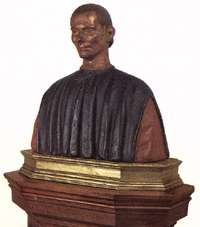 Florentine political theorist and dramatist. After an adequate humanistic education, Machiavelli entered the bureaucracy of the republican government in 1498, chiefly being employed as secretary to the Ten of War, the committee responsible for the conduct of military and diplomatic affairs. This daily contact with affairs of state, supplemented by missions which took him to the courts of some of the chief actors in the political events of these years (Louis XII, Maximilian I, Julius II, Cesare Borgia), stopped abruptly with his dismissal in 1512 on the re-establishment of Medicean control over Florence. The closeness of his involvement with the previous régime and its titular leader, Soderini, and his suspected collusion in an anti-Medicean plot early in 1513, led to Machiavelli's bitterly regretted but permanent exclusion from government employment save for a trifling errand in 1521 and a temporary secretaryship (to a commission inspecting the fortifications of Florence) in 1526.
Living in enforced retirement on his farm in the small village of S. Andrea in Percussina, 7 miles South of Florence, he produced the works on which his renown is based: Il principe (The prince), 1513; Discourses on the first decade of Livy, 1513 or (more probably) 1516 to 15199; Mandragola, 1518; The art of war, 1519-20; The history of Florence, 1520-25. Of these, only Mandragola and The art of war were published before his death: Il principe was first published in 1532.
Machiavelli was an ardent if unscholarly student of the political structures and leaders of antiquity: for him humanism meant access to lessons that could be applied in his own day. He was a natural, zestful writer, effective whether arguing a point of statecraft, describing in letters his somewhat rackety style of life, or composing his poetry (now unread) and his still most stageable plays; Mandragola is the finest comedy written in Italy before Goldoni, and Clizia (1524 or 1525) is scarcely inferior. The energy of his political writing was sustained by certain passionately held convictions: that his own experience qualified him as a pundit; that the unchanging nature of men and the recurrence of political and strategic situations meant that the present could and should learn from the past; that politics, a matter of dealing quickly with converging public contingencies, could not be dealt with in terms of a morality tailored to the individual and his long-term chances of salvation in Christian terms; that republics were preferable to princely governments when territorial limits were stable and the citizens politically mature enough to share selflessly the burdens of office; that native troops were vastly superior to mercenaries or to soldiers loaned by an ally; that political success depended upon vigilance, sensitivity to the purport of events, activism, a nicely calculated unscrupulousness.
Machiavelli was neither an atheist nor the advocate of trickery or cruelty for its own sake, but the equivocal relationship between the polemical tone of his personal convictions and his insistence that he is merely describing how things are, rather than how they ought to be, maintains today something of the power to shock that made him into the evil 'Machiavel' of political folklore in the late 16th century.
