Medici, Cosimo de' (1389-1464)
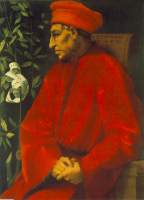 From 1434, when he was recalled from the exile to which he had been sentenced in the previous year, Cosimo's influence in Florentine governing circles was so dominant as to create a feeling that, without a member of his family to give the lead, Florence would relapse into a damaging political free-for-all. He thus became the founder of a dynasty that, fairly covertly in the 15th century, openly in the 16th and 17th centuries, directed the fortunes of Florence. To achieve this in a city where wealth was granted more authority than breeding required a fortune. This Cosimo inherited from his banker father Giovanni, and, inheriting too a flair for business, he increased it. Shrewd in his choice of partners and managers, methodical as a book-keeper and imaginative as an investor; Cosimo derived his wealth from commerce and industry as well as from banking, and it brought him both an involuntary respect and the means of buying more; given the city scale of most Italian statecraft, it is not without reason that he has been compared to the 'boss' of Chicago or Dallas ward politics or the 'padre' of a power zone of the Mafia. Aided by his father (d. 1429) and supported by his anker cousin Averardo (d. 1434), Cosimo had left behind on his banishment (by the then dominant Albizzi régime) a party which lost no time in bringing him back, and thereafter hardly faltered in seeing him as the continuing guarantee of protection from governmental decisions that would hurt their persons, profits, or standing within the city.
To high ability as a financier, and to genius as a party manager, Cosimo added two qualities that distinguish him from others who had mastered the practical details that ensured a successful political career. As a politician he had a vision that looked beyond Florentine Tuscany. This was helped, indeed necessitated, by the conduct of a firm with international interests. But it was more than just business acumen that eventually persuaded his political colleagues to give him a fairly free hand in actually negotiating, as well as determining, the city's foreign policy - and that led them to accept the opinion of foreign princes that Cosimo was really the ruler of Florence. (They watched his encouragement, and later support of, Francesco Sforza's takeover of the duchy of Milan with considerable reserve before accepting it as in Florence's interest.)
The second 'extra' quality is less tangible: Cosimo's respect for, and indeed dependence on, the qualities of pure intellect possessed by others. It was not just a shrewd deference to the ideal of patronage that made him buy manuscripts and found libraries (at S. Marco, at the Badia of Fiesole, and his own - now known as the Laurenziana, not from his grandson, Lorenzo the Magnificent, but from the church of S. Lorenzo which houses it), support scholars of the calibre of Argyropoulos and Marsilio Ficino (to whom he gave his start in life), and take so strong an interest in Donatello and Michelozzo (who designed his palace). Patronage involved status if the right horses were backed, and Cosimo was ambitious for himself and his descendants. All the same, there is evidence that Cosimo sensed a genius in others that was derived from values beyond (though not irrelevant to) his own aspirations, which marks him as more than simply abreast of what his society had to offer.
His character remains unfocused though far from enigmatic, as far as his contemporaries reveal it: indeed, the emphasis these place on his patriarchal simplicity of manner and homespun wisdom expresses the desire to dornesticate a many-fronted energy that was to be rivalled by none of his descendants.
