|
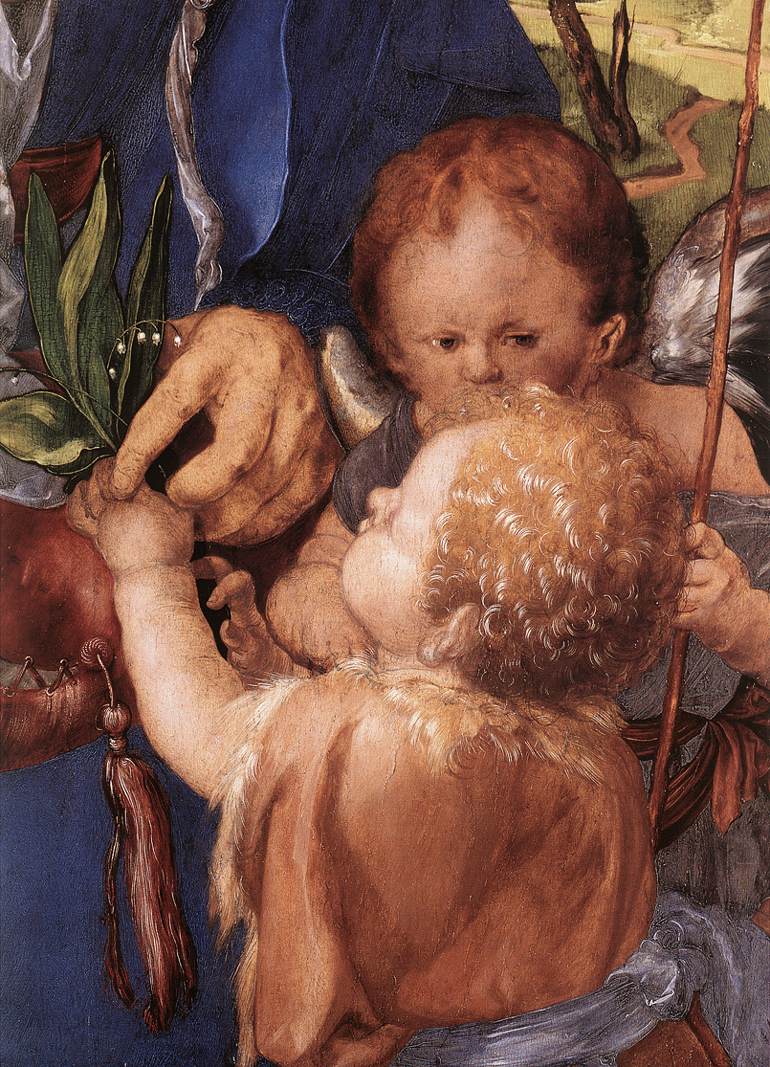
The Virgin, depicted here with flowing, fair hair, is seated before a red backcloth in a landscape, while two angels hold a garland of roses over her head. The Child is shown playing with a siskin and holding a sugar-castor in his right hand. The Madonna's left hand rests on a book, and with the other she takes a spray of lily of the valley which the young Saint John is holding out to her.
On a wooden bench in the foreground lies a piece of paper bearing the painter's signature in Latin : `Albertus durer germanus faciebat post virginis partum 1506'. That Dürer should here describe himself specifically as German is not surprising when one takes into account his admiration for the Italian artists. He has included quite a few Venetian touches in this picture and was obviously proud of his achievement. The type of half-length figure he has adopted for the Madonna is modelled on southern paintings and the characteristic blue and red colour-scheme is adopted from Giovanni Bellini, whom Dürer, as he wrote in a letter to Nuremberg at the time, regarded as `the best of all painters'. The flying cherubim, bodyless angels, were also derived from the Italian Renaissance masters. Saint John, presenting the flowers, is closely akin to the small figure in Titian's Madonna of the Cherries in the Vienna Gallery, which was not painted until the second decade of the century. Here the Venetian master showed his respect for the German artist.
Quite a lot is known about Dürer's visit to Venice in 1506. He received a major commission from the German merchants at the Fondaco dei Tedeschi, who later also commissioned works from Giorgione and Titian; Dürer's work, the Festival of the Rosary, now in Prague, proved a difficult task which kept him busy and preoccupied for a long time, as he himself admitted; as a result he lost other commissions. He had only the last quarter of the year 1506 in which to complete the Madonna with the Siskin, for the following spring he returned to Nuremberg; thus it became an Italian Christmas picture, as the inscription `after the confinement of the Virgin' expressly states. There are four extant studies for this painting, in which the Child, the cherubim and a piece of drapery are portrayed (Bremen, Paris, Vienna). These sketches also show how closely the creation of the Berlin panel was linked with the Festival of the Rosary.
Painted for an unknown patron, the work was probably in the palace of Rudolf II in Prague, assuming that Carel van Mander's description of 1618 - `a Madonna, over whom two angels hold a garland of roses, with which to crown her' - refers to this painting. How it came from Italy to Prague is as much a mystery as its subsequent movements. In the 1860s the panel was rediscovered in Scotland; it was in Newbattle Abbey near Edinburgh in 1892 when it was acquired for the Berlin Gallery from the Marquess of Lothian.
|