|
Gaudí's first major building commission for the Palau Güell came from his sponsor and later close friend, Count Eusebio Güell, a much-travelled patron of arts. On his business trips to England, Güell had come into contact with William Morris and had put together an extensive library of contemporary writings on art theory, which Gaudi often consulted.
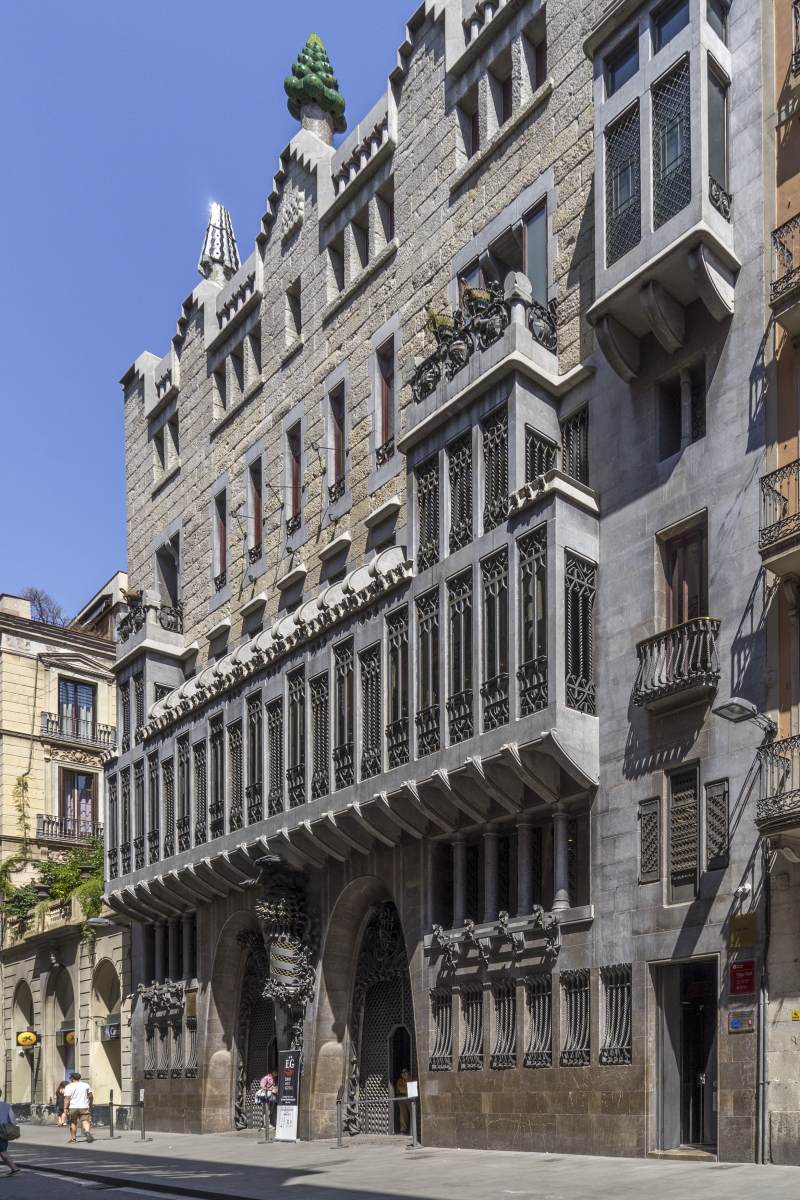
The Palau Güell, a grey marble urban building of six storeys, presents a relatively simple façade to the street, but the twin parabolic arches at the entrance and the bay windows, particularly at the rear, have a wealth of wrought-iron ornament. Together with the furniture designed for the Güells, this is among the earliest manifestations of the incipient Catalan Modernisme, the regional tendency related to Art Nouveau. There is also a series of sculpted roof elements behind the symmetrical parapet gables. The internal areas were unified around a magnificent central space covered with a parabolic vault, naturally lit from above through parabolic arches in the octagonal, pinnacled cupola.
With the Palau Güell, structure and decoration began to fuse - a feature that later became characteristic of his principal works. Gaudí made use of the varied decorative opportunities of structural iron in all their abundance. In addition, he employed flattened brick vaults of Byzantine derivation that even today are copybook examples of stereotomy.
|