|
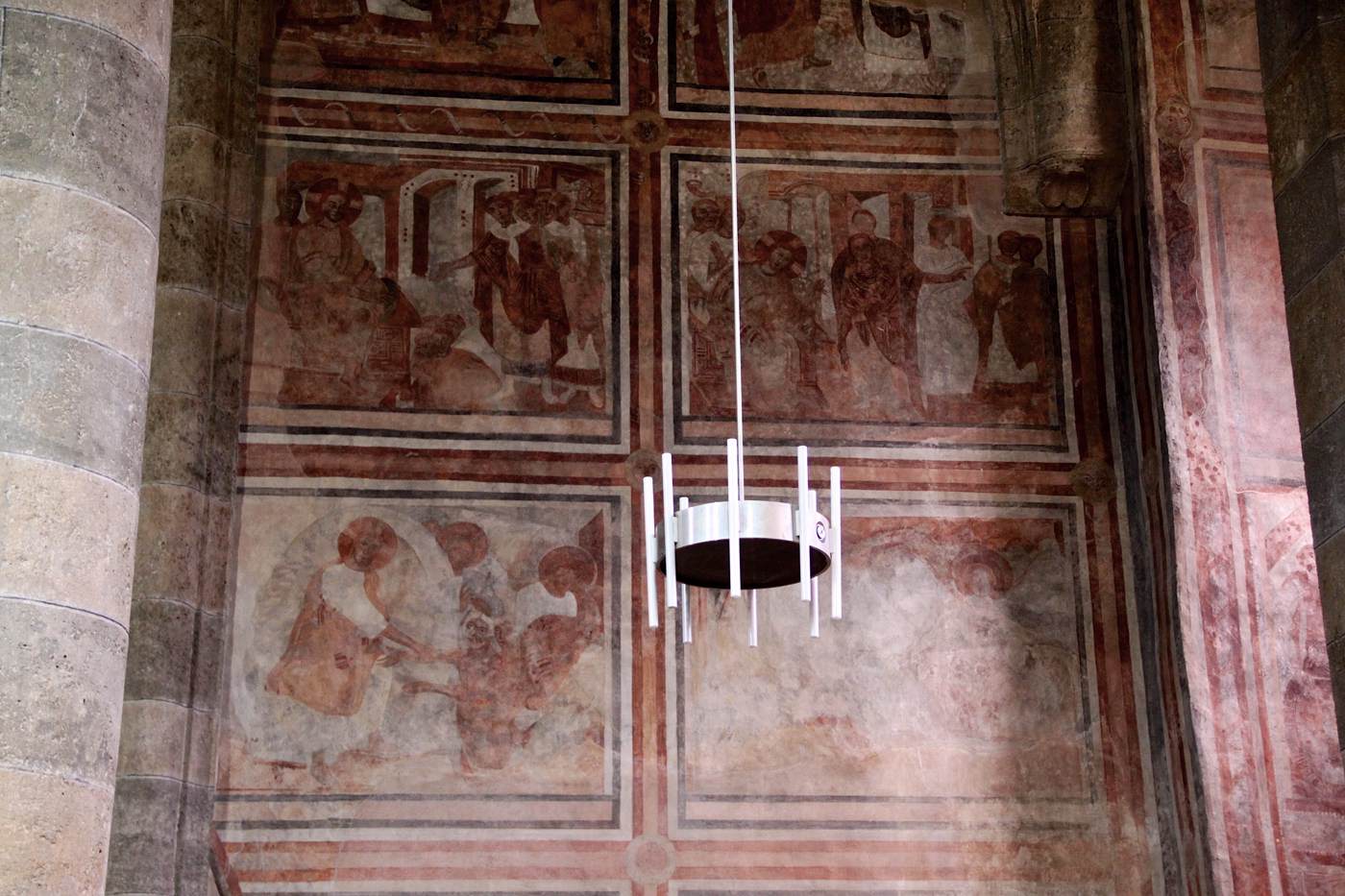
The best preserved Carolingian fresco cycle can be found in a remote valley in Graubünden, in the monastery church of Müstair. The church is dedicated to St John the Baptist, and it is generally believed to have been founded by in about 790, and probably by Charlemagne. One can assume that the frescoes were painted soon after the completion of the monastery church. Located in the apses, the paintings remained undiscovered until 1896 and were finally completely uncovered by 1950. Parts of the frescoes had been painted over in the twelfth century by artists belonging to the School of Salzburg.
The artists who executed the paintings did not belong to Charlemagne's court school. Extensive commissions were taken on by itinerant artists who came from Italy and were trained in Byzantine style. The Byzantine influence can be found not only in the shapes but also in the treatment of the pictorial narrative, that is the manner in which the individual scenes are emphasized by the articulation of the architectural elements around them.
|