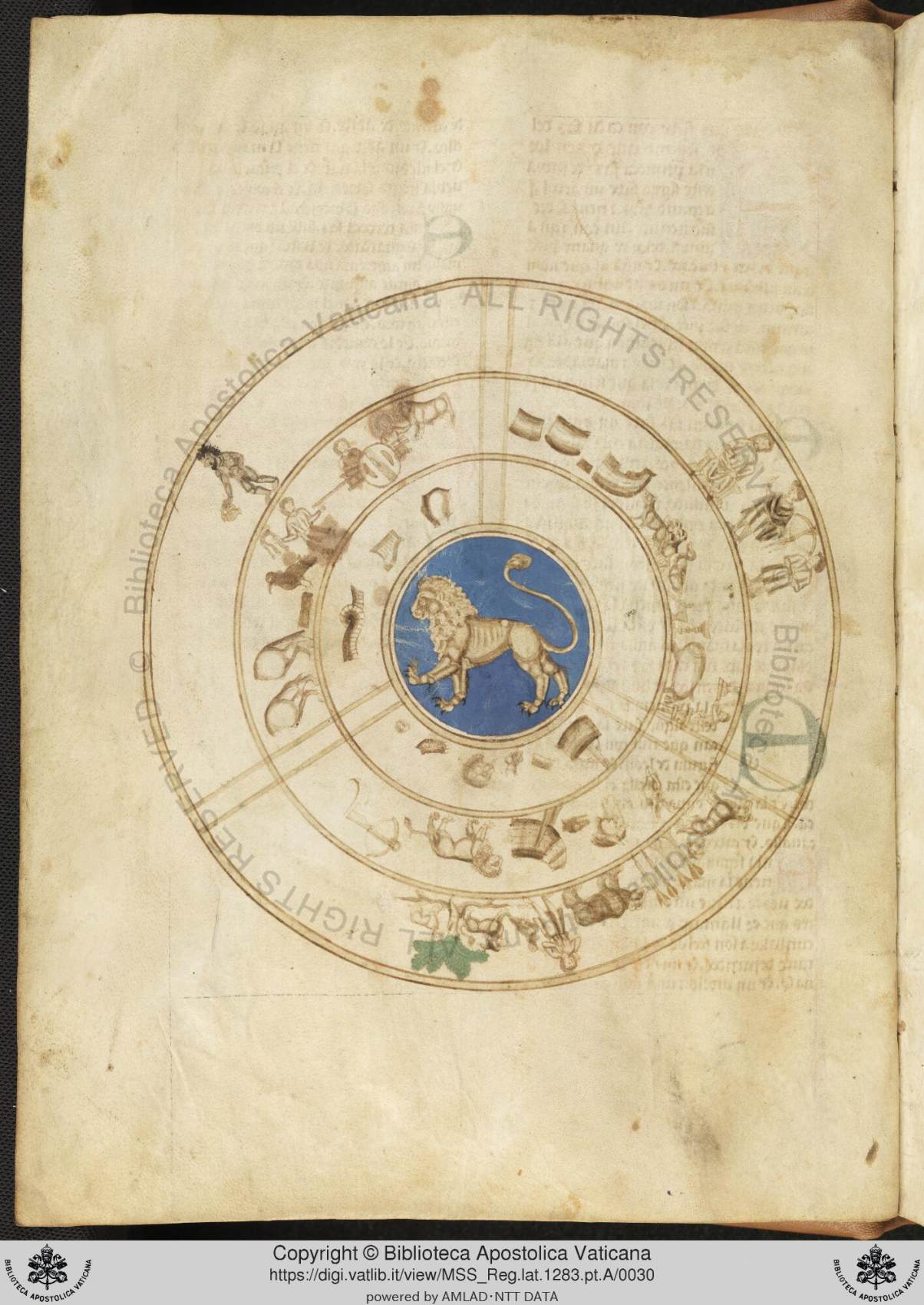
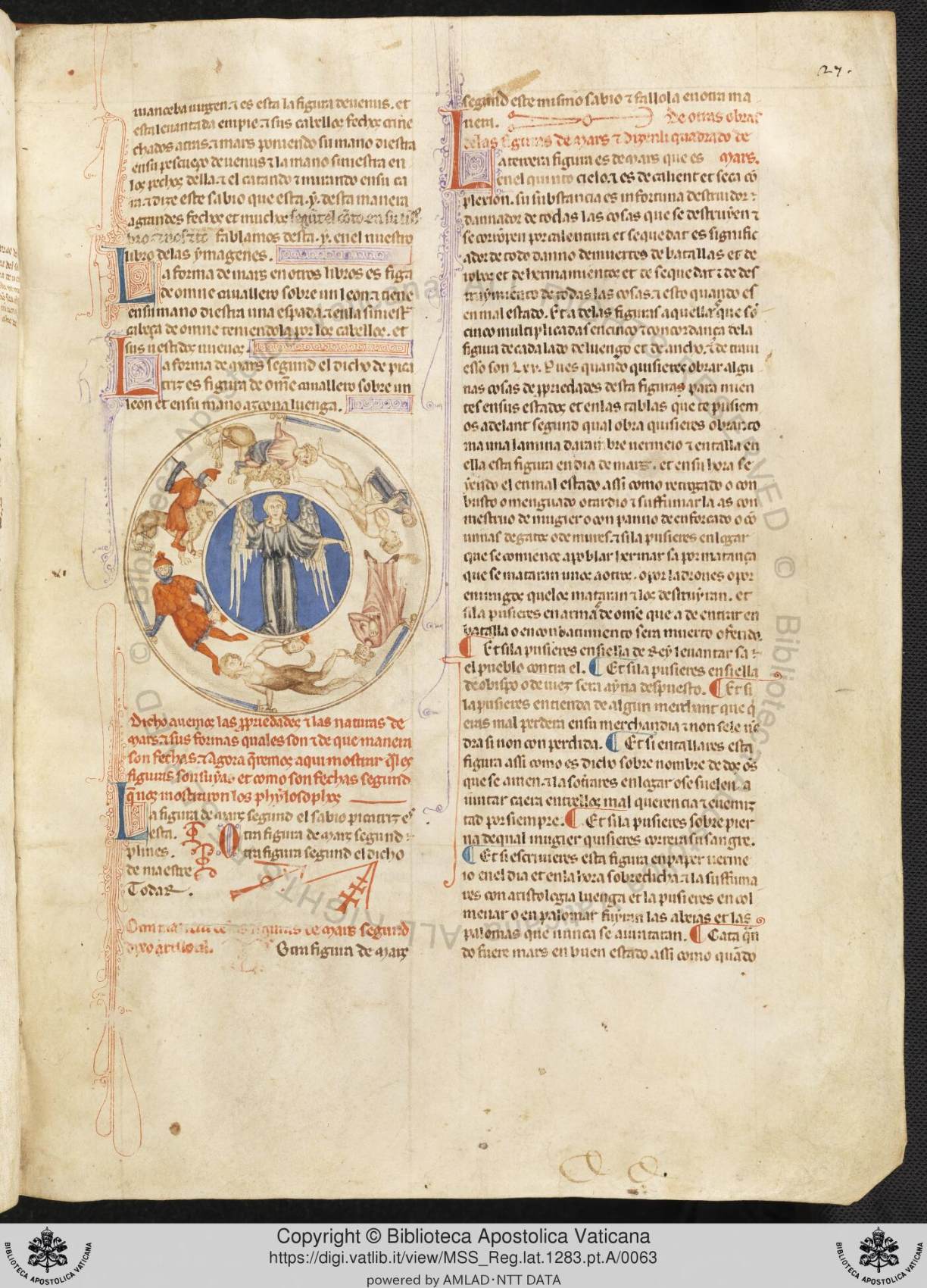
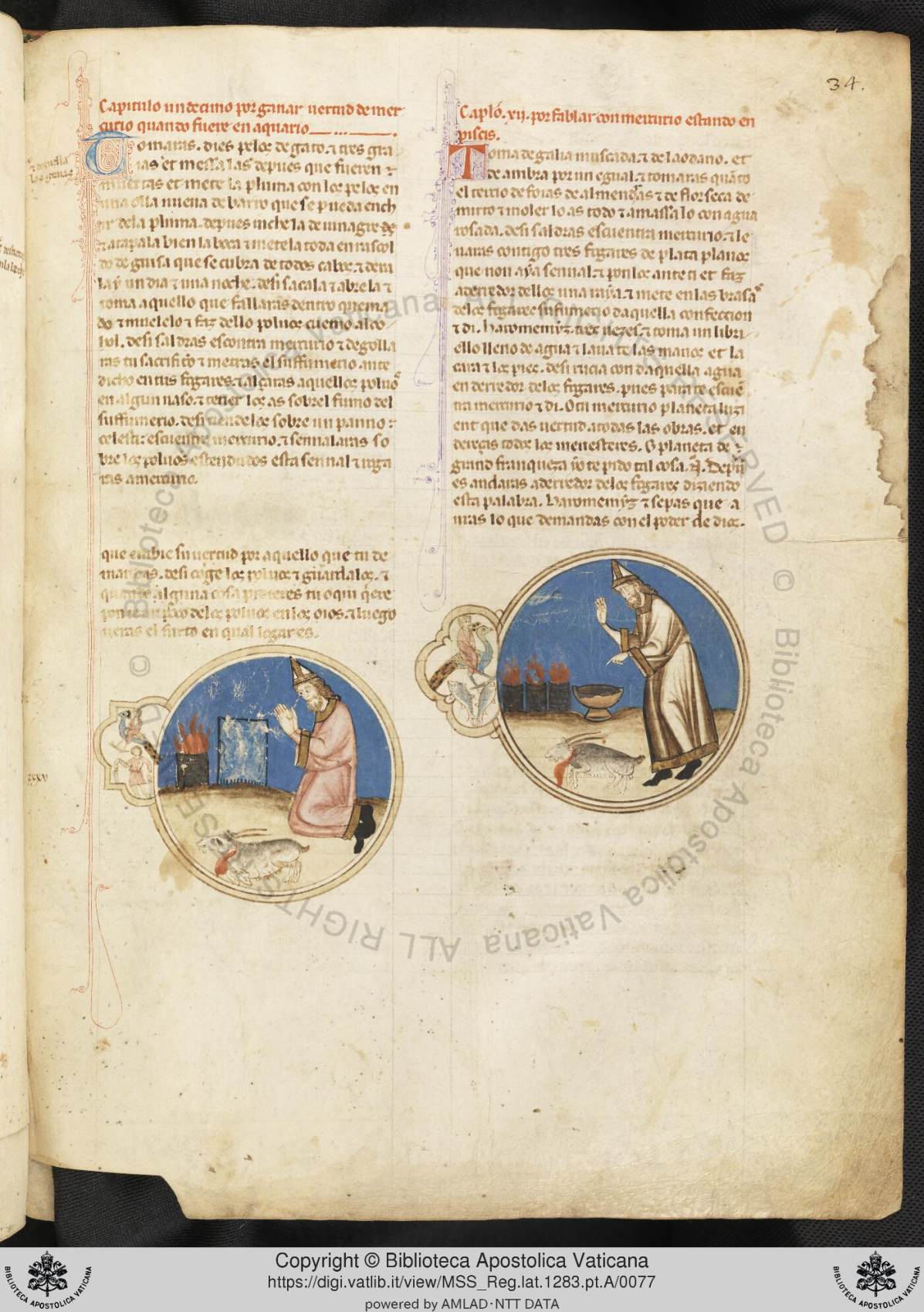
The manuscript in the Biblioteca Apostolica Vaticana (Shelfmark: Reg.lat.1283.pt.A) is a historically significant composite codex of medieval texts and fragments. It was executed by at least three independent Gothic scribes in King Alfonso X of Castile's scriptorium in the 1270s. The manuscript is highly fragmented, divided into two main parts.
Part A (folios 1-36) contains the Libro de Astromagia, created between 1276 and 1279 for Alfonso X. This illuminated book features astronomical and astrological lore translated into Latin and Castilian from Arabic sources.
Part B (folios 37-154) contains a diverse collection of unrelated texts.
The illustrations of the Libro de Astromagia form a remarkable pictorial cycle. Unlike the more familiar astronomical illustrations of other manuscripts, these miniatures were conceived primarily as functional astrological diagrams. Their purpose was to visualise the relationships between zodiacal signs, decans, constellations (paranatellonta), planets, angels, and magical operations derived from Arabic astrological literature.
The Libro de Astromagia is not merely an "illustrated book" in the traditional sense. It is a visual scientific instrument with full-page zodiac charts and modular, circular diagrams, reflecting the movement from general cosmological theory to the specific, practical application of magic.
| Summary of illuminated manuscripts (miniatures) |
| Late Antique and Pre-Romanesque periods |
| 351-400 | 401-450 | 451-500 | 501-550 | 551-600 | 601-650 | 651-700 |
| 701-750 | 751-800 | 801-850 | 851-900 | 901-950 | 951-1000 |
| Romanesque period |
| 1001-1050 | 1051-1100 | 1101-1150 |
| Early and High Gothic periods |
| 1151-1200 | 1201-1250 | 1251-1300 |
| Late Gothic and Renaissance periods |
| 1301-1350 | 1351-1400 | 1401-1450 | 1451-1500 | 1501-1550 |
| Book covers |
| Illuminations by known masters |
| List of illuminators |